Padel is often described as a cross between tennis and squash, because the walls are in play. But padel and squash feel completely different. Squash is usually one against one inside a closed room, hitting the ball against the front wall. Padel is two against two over a net, with glass walls you can use after the ball bounces.
Short answer: squash is played in a closed 9.75m × 6.4m room, usually one against one, by hitting a small rubber ball against the front wall. Padel is played in pairs over a net on a 20m × 10m court enclosed by glass, with a solid racket and a felt ball. Padel is easier to start and more social; squash is more intense and demands more fitness.
Padel vs squash at a glance
| Padel | Squash | |
|---|---|---|
| Court | 20m × 10m, net in the middle, glass and mesh walls | 9.75m × 6.4m, four solid walls, no net |
| How you play | Over a net; walls are used after the ball bounces | Hit the ball against the front wall, above the tin |
| Players | Almost always doubles | Usually singles (doubles needs a wider court) |
| Racket | Solid foam core with holes, short handle | Strung, long-handled (up to 68.6cm) |
| Ball | Low-pressure felt ball | Small hollow rubber ball (yellow-dot for experienced players) |
| Serve | Underarm, after a bounce, diagonally over the net | Overarm or sidearm, onto the front wall above the service line |
| Scoring | 15, 30, 40, game; sets to 6 | Games to 11, point-a-rally, best of 3 or 5 |
| Intensity | Social and athletic | Very intense, constant movement |
| Typical UK cost | £28 an hour per court off-peak, shared by four | Usually cheaper per court, shared by two |
The court and the walls
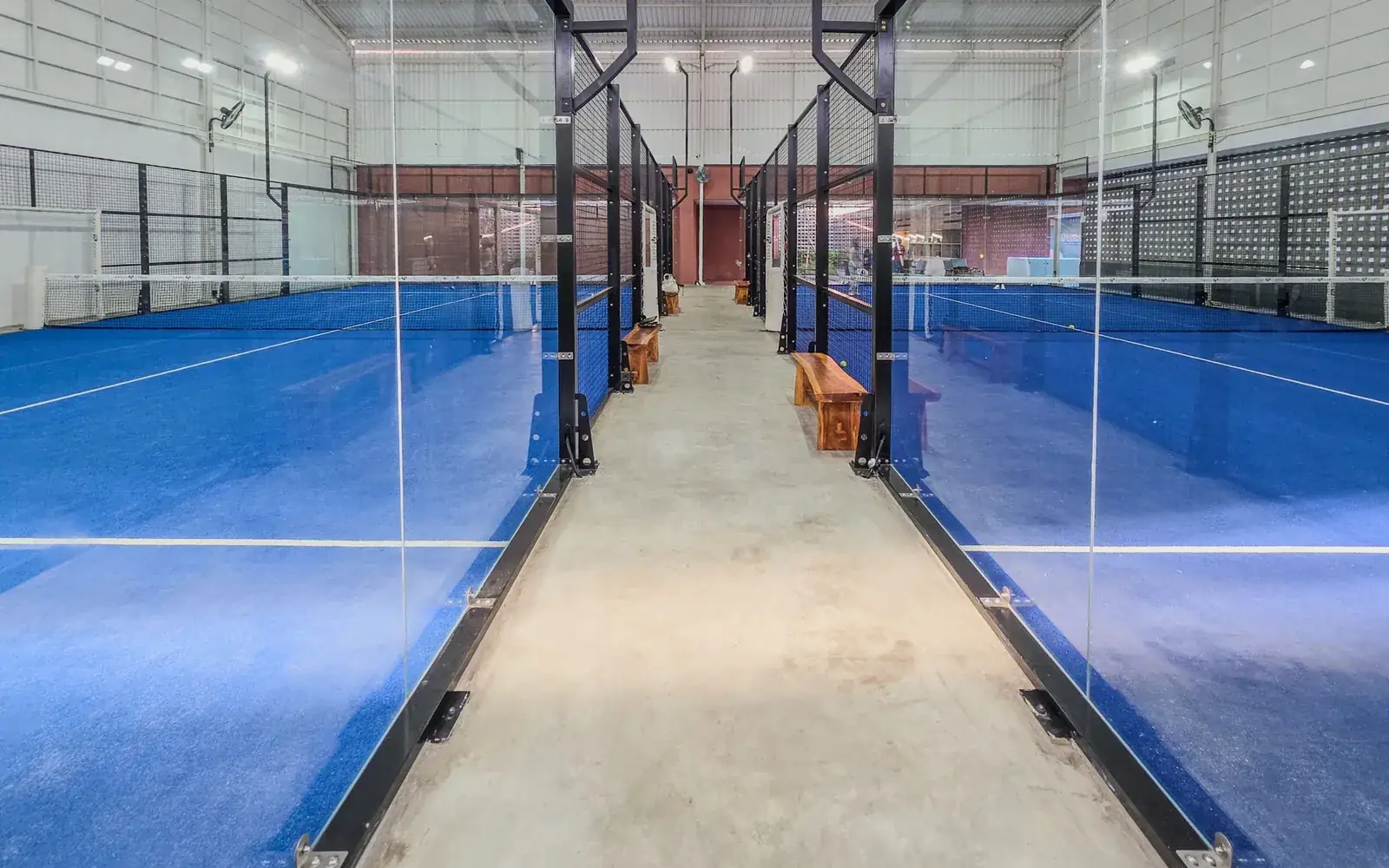
A squash court is a closed room 9.75m long and 6.4m wide, with a front wall, side walls and a back wall, often glass. A padel court is twice as long and much wider (20m × 10m), split by a net, and open at the top. In squash, every shot must hit the front wall above the tin. In padel, the ball must go over the net first and may only be played off the walls on your own side after it has bounced.
That one rule is the biggest difference. Squash players are used to hitting the ball into walls on purpose. In padel, hitting the opposite glass before the ball bounces loses you the point. Squash players who move to padel have to learn to keep the ball low over the net and let the walls work on their own side.
Players: singles vs doubles
Squash is mainly a singles game, and doubles squash needs a special wider court that few UK clubs have. Padel is the reverse: almost everyone plays doubles, and singles needs a narrower court. That makes padel easier to organise as a social game with friends or colleagues, and easier to share the cost.
Rackets and balls
A squash racket is long, light and strung, built for whippy wrist shots. A padel racket is short and solid, with no strings and a wrist strap. The balls are very different too: squash uses a small rubber ball that has to be warmed up before it bounces properly, and the double-yellow-dot ball used by good players barely bounces at all. A padel ball is a lower-pressure version of a tennis ball, so it bounces predictably off the glass.
Scoring
Squash games go to 11, with a point scored on every rally, and you must win by two. Matches are usually best of three or five games. Padel uses tennis scoring: 15, 30, 40, game, with sets to six games. See our padel rules and scoring guide for the golden point and the 2026 Star Point.
Fitness: which is the harder workout?
Squash is one of the most demanding racket sports there is: constant short sprints, lunges and turns in a small room with almost no rest between points. Padel is a good workout but more forgiving. Because there are four players on a bigger court and the walls slow the game down, there is more time to recover, which is why people of very different fitness levels can enjoy playing together.
Which is easier to learn?
Most people find padel easier. The underarm serve, the bigger, slower ball and the walls keeping rallies alive mean beginners have fun in their first session. Squash rewards fitness and technique and can feel tough at first, especially working out how the ball comes off the back corners.
Squash is shrinking, padel is growing
Squash was a boom sport in 1980s Britain. Squash Player magazine reported close to three million players at the time. Numbers have fallen a long way since: Sport England’s Active Lives survey found 264,100 adults in England played squash or racketball at least twice in four weeks in 2021-22, down by more than 30,000 on the year before the pandemic. Padel has gone the other way: the LTA estimates 1.5 million people now play in Britain, up from around 15,000 in 2019.
Many squash clubs and leisure centres have responded by adding padel courts, and some old squash venues have been turned into padel clubs. If your squash partner has drifted away, padel is a good way to bring a group back together.
If you play squash, will you like padel?
Probably. Squash players read angles and walls well and have quick hands, both of which help in padel, especially at the net. The big adjustments are playing in a pair, letting the ball bounce before it hits the glass on your side, keeping the ball low over the net and the underarm serve. Many squash players find padel less punishing on the body and more sociable.
You like doubles, want to rally quickly and prefer a game you can play with friends of mixed ability.
You like one-on-one competition, have a club nearby and want maximum fitness in 45 minutes.
Many players keep squash for a hard session and padel for a social game.
Questions people ask
What is the difference between padel and squash?
Squash is played in a closed room, usually one against one, by hitting the ball against the front wall. Padel is played in pairs over a net on a larger court enclosed by glass, and the walls can only be used after the ball bounces on your side.
Is padel like squash?
A little: both use walls. But padel is played over a net in pairs, with a solid racket and a felt ball, while squash is played against the front wall with a strung racket and a small rubber ball.
Is padel easier than squash?
For most beginners, yes. The underarm serve, bigger ball and walls keeping rallies alive make it easier to start and less physically punishing.
Is squash a better workout than padel?
Squash is usually more intense, with constant sprints and little rest. Padel is still a good workout but more forgiving, because there are four players and longer rallies.
Can squash courts be used for padel?
No. Padel needs a 20m × 10m court with a net and glass walls, about three times the floor area of a squash court.
Do squash players make good padel players?
Often. They read the walls well and have quick reactions at the net. They need to adjust to doubles, the net and not hitting the opponents’ walls.
Is squash dying in the UK?
Squash participation has fallen a long way since the 1980s, and Sport England figures show it still declining. It remains popular at clubs, while padel is growing much faster.